


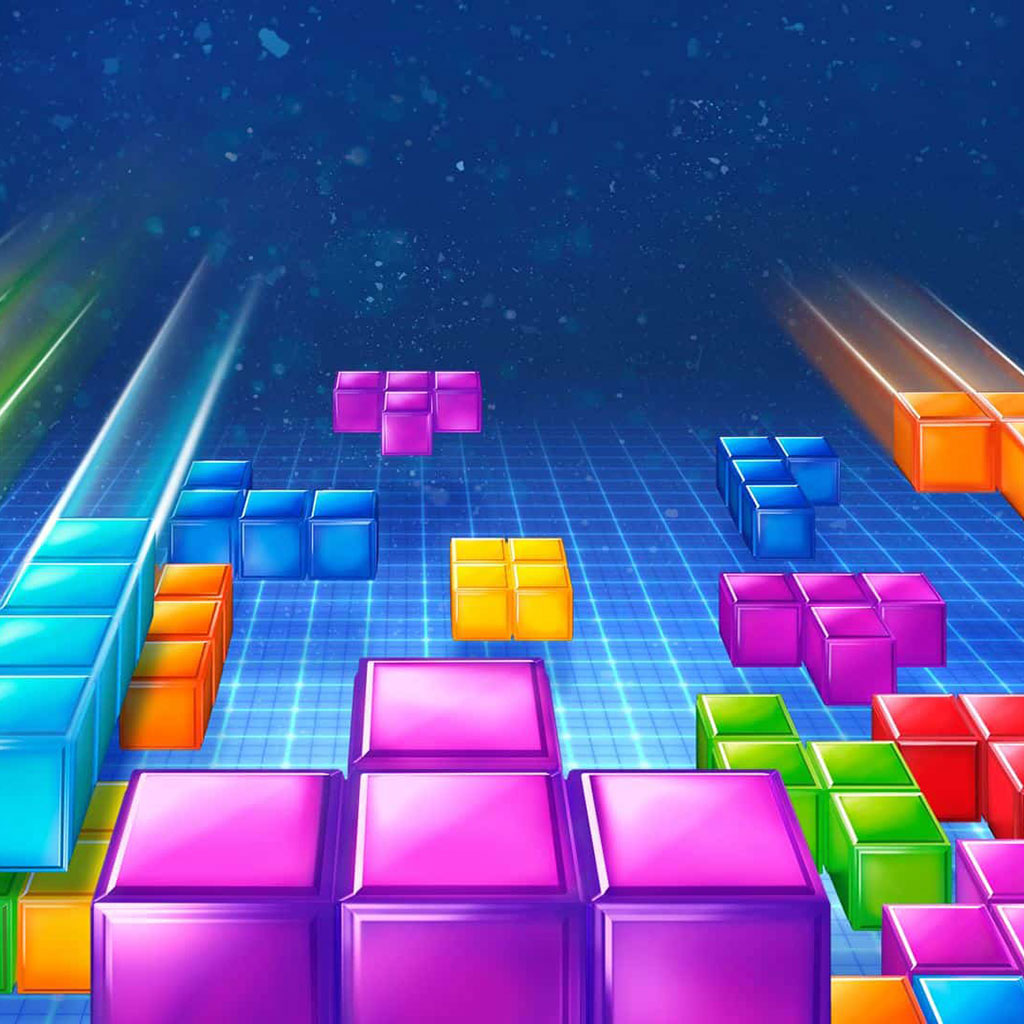

Tetris »Retrospective« – 1984 (Elektronika 60, Game Boy, NES, PC, Amiga, Atari, Arcade Cabinets) / (Everywhere)
Tetris began its journey in 1984, born from the mind of Soviet engineer Alexey Pajitnov and originally coded for the austere Elektronika 60. Despite these humble beginnings, the game quickly escaped its laboratory roots and spread across virtually every platform imaginable, from early PCs to Nintendo consoles, all the way through PlayStation, Xbox, handheld systems, and modern smartphones. Its power lies in a concept so clean and elemental it feels timeless: a gameplay loop built around rotating and stacking the seven iconic Tetrominoes, colorful geometric shapes made of four blocks.
Over the years, Tetris has been published by a variety of companies, including Spectrum HoloByte, Sega, Nintendo, and, in more recent decades, The Tetris Company, securing its place as one of the most recognized and widely played videogames on the planet. Even today, it stands as a perfect example of pure game design, captivating new generations with the exact same immediacy that defined it in the ’80s.
The origins of Tetris trace back to a place few would associate with videogame creativity: the research labs of the Soviet Academy of Sciences, in Moscow, 1984. This was where Pajitnov, a young programmer with a passion for logic puzzles and geometric challenges, worked daily. His original intention wasn’t to create a commercial game, but simply to test the capabilities of the Elektronika 60, a spartan computer without a real graphical interface. Yet from those limitations, something brilliant emerged.
Pajitnov was inspired by Pentominoes, mathematical puzzle pieces made of five blocks. To fit the constraints of the Elektronika’s monochrome display, he simplified them into shapes made of four blocks instead, this is how the Tetrominoes were born, the very soul of Tetris. A few lines of code and a strikingly intuitive idea were enough: let the pieces fall from above, and let the player bring order to chaos.
The game spread organically among Soviet researchers and programmers, copied from floppy disk to floppy disk. In a country where Western software rarely entered and Soviet programs rarely left, Tetris still managed to slip across borders, first reaching Hungary, then Western Europe, and eventually the United States. There were no marketing campaigns, no official distribution. Tetris spread simply because it was irresistible.
That underground success soon sparked interest from international publishers and software companies, triggering a complex and often dramatic rights battle, a real-life legal thriller that today feels straight out of a Cold War novel. Yet everything began with a simple idea, crafted almost casually in a nondescript Moscow office.

At its core, Tetris is built on a concept as simple as it is ingenious: make order out of chaos. From the top of the screen, one Tetromino at a time drops into the playing field, seven distinct shapes, each with its own personality.
All types of Tetris pieces (Tetraminos):
Nintendo and The Tetris Company have defined 7 official pieces, each identified by a letter corresponding to its shape.
1) I – “Line” Tetromino
Shape: A straight line of 4 blocks
Classic color: Light Blue
Feature: Ideal for playing Tetris (4 lines together)
2) O – “Square” Tetromino
Shape: 2×2
Classic color: Yellow
Feature: Does not rotate, very stable
3) S – “S” Tetromino
Shape: Zigzag to the right
Classic color: Green
4) Z – “Z” Tetromino
Shape: Zigzag to the left
Classic color: Red
5) T – “T” Tetromino
Shape: T-shaped
Classic color: Purple
Feature: One of the most technical pieces (T-spin)
6) L – “L” Tetromino
Shape: L Reversed
Classic color: Orange
7) J – “J” Tetromino
Shape: Regular L
Classic color: Blue

They fall steadily from above, and the player can rotate, shift, and drop them into place. The goal is to create complete horizontal lines that disappear, freeing space and increasing the score. The idea is effortless to grasp, yet the depth is astonishing.
A match usually starts calmly enough, with pieces dropping at a leisurely pace that allows planning and experimentation. But as levels climb, the tempo accelerates. Decisions shrink to fractions of a second, and the player slips into a mental state somewhere between instinct and concentration, the famous flow state, where the outside world fades and only the dance of shapes remains.

Despite its simplicity, Tetris supports a surprising variety of play styles. Some players build tall, tidy stacks waiting for the perfect I piece to score a full four-line clear. Others play clean and methodical. Experts dive into advanced techniques like the T-Spin, capable of salvaging impossible positions at the last moment.
Another strength of Tetris lies in its visual clarity. No clutter, no distractions, just a crisp playfield and instantly recognizable shapes. It’s this minimalist precision that has made Tetris one of the most accessible videogames ever created, appealing to children, adults, casual players and dedicated fans alike.
Then comes the soundtrack, particularly in the most iconic versions, speeding up as tension rises and easing off when the field is cleared. It breathes with the player, turning every match into a rhythmic experience.
Ultimately, Tetris is a puzzle built on a perfect balance: easy to learn, hard to master, impossible to forget.
Few videogames have left a cultural footprint as deep as Tetris. From the moment it crossed beyond the Soviet Union, Pajitnov’s creation became a global phenomenon, one that transcended the boundaries of gaming to become a symbol of the digital age.
One of the most striking aspects of its impact is the universality of its visual language. A single Tetromino is enough to summon the entire game to mind. No mascots, no epic storyline, no characters, yet Tetris is instantly recognizable, right alongside icons like Pac-Man and Space Invaders. Its modular, geometric aesthetic has become a design emblem capable of adapting to any era or technology.
Its influence extends far beyond entertainment. Artists, architects, and designers have used Tetrominoes as metaphors for order, transformation, and balance. Around the world, massive light installations have turned skyscrapers into playable Tetris boards, drawing crowds of thousands. New York famously hosted a building, sized game that lit up the night like a giant digital mural.
Tetris has also become a subject of scientific and psychological research. Its repetitive, pattern, based gameplay led to the discovery of the Tetris Effect, where players continue to visualize falling blocks even with their eyes closed. Researchers have explored this effect to understand spatial memory, learning mechanisms, and even therapeutic applications.
The game reshaped the puzzle genre as well. From Dr. Mario to Puyo Puyo, from Lumines to Columns, every major puzzle title released after 1984 owes something to the legacy of Tetris: elegant simplicity, rising tension, and infinite replayability.
Its cultural resonance reached a new peak with the film “Tetris” (2023), which dramatized the intense rights battle involving the Soviet Union, Europe, Japan, and the United States. The movie reintroduced the game’s fascinating backstory to a modern audience, highlighting just how extraordinary its journey has been.
Nearly forty years after its creation, Tetris remains a reference point not only for players but for anyone interested in digital culture. It represents creativity, abstraction, rhythm, and the beauty of structure. Despite its simplicity, it continues to inspire new generations and creative fields, proving that video games are not just entertainment, they’re culture, art, and a universal language.
There are many reasons why Tetris remains captivating even decades later. It speaks to everyone: you don’t need complex controls or gaming experience to enjoy it. Within seconds, you understand what to do, and suddenly you’re caught in a race against an accelerating rhythm, a test of clarity, timing, and instinct. This purity makes Tetris timeless.
Of course, like any great classic, it hides a competitive edge. As the speed increases, the margin for error tightens. A single misplaced piece can collapse a perfect strategy. It’s part of its charm, but also a quiet warning: Tetris can be as calming as it is ruthless.
Over time, countless curiosities have enriched its legacy. The Tetris Effect, for example. Or the fact that the Game Boy version played a decisive role in shaping the handheld gaming market. And the international legal battle that eventually led to the formation of The Tetris Company, which still oversees the brand today.
Modern titles like Tetris 99 and Tetris Effect show how alive the franchise still is, even in 2025, offering fresh, inventive ways to reinterpret the core idea without betraying it.
In the end, what makes Tetris truly special is its resilience. It doesn’t age because it’s not tied to any one technology, trend, or era. It’s pure design, a perfect equilibrium between order and chaos, logic and instinct. In a world that changes at breakneck speed, Tetris remains a constant: an eternal puzzle that always offers something new, whether you play for five minutes or for a lifetime.
Tetris Retrospective: (Video Game Retrospectives, Android Games, Atari Games, iOS Games , GameCube Games, GB Games, GBC Games, GBA Games, N64 Games, NDS Games, N3DS Games, NES Games, PC Games, PS Vita Games, PSX Games, PS2 Games, PS3 Games, PS4 Games, PS5 Games, PSP Games, SEGA Games, SNES Games, Switch Games, Wii Games, Wii U Games, Xbox Games, Xbox 360 Games, Xbox One Games, Xbox Series X/S Games)
Tetris: (Arcade Games)






Leave a Reply